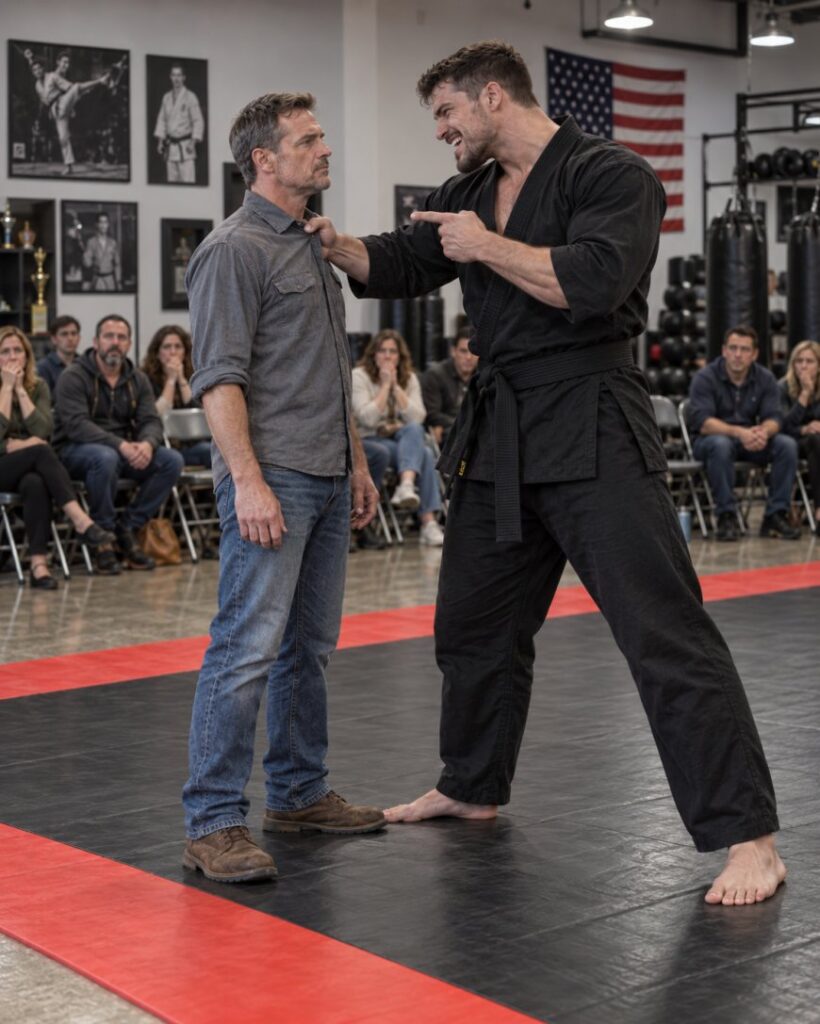
PART 2
The days after that afternoon at Iron Crest Martial Arts moved the way days move in a small town — quietly, without announcement, carrying their own weight.
I didn’t tell anyone what had happened. Not the men at the construction company, not the woman at the grocery checkout who knew my name but not my history, not the neighbors who waved when I drove past. In Cedar Falls, you could keep your business to yourself if you wanted to, and I wanted to. I had spent nine years carefully building a version of myself that fit neatly into this town — the quiet guy from the far end of Milbrook Lane who fixed things for a living and raised his son alone and never left his trash cans out past Tuesday.
That version was still real. But something had shifted.
Evan knew it before I did. He watched me differently in those first few days, with a kind of sideways attention that reminded me of Sarah. She had always been able to see through me — not with confrontation, but with patience. She would wait for me to say the thing I was holding back, and when I finally said it, she would nod as if she had already known and had simply been waiting for me to catch up.
Evan had her patience. He also had my stubbornness. The combination made him difficult to read unless you were paying very close attention.
On Monday morning, I drove him to school the way I always did. The Silverado hummed along the familiar route — past the gas station, past the hardware store, past the stretch of road where the trees thinned and the houses got a little older and a little smaller. Evan sat in the passenger seat with his backpack between his feet and his hands in the front pocket of his hoodie, looking out the window.
He hadn’t asked me anything else about that afternoon. Not yet. But I could feel the question sitting between us, patient and heavy.
When I pulled up to the curb in front of Cedar Falls Middle School, he didn’t get out right away. He sat there for a moment, watching the other kids stream through the front doors. Some of them were laughing. Some of them were looking at their phones. Some of them were standing in small clusters, talking in the way kids do when they’re trying to figure out where they belong.
Evan belonged somewhere in that crowd. He just hadn’t figured out where yet.
“Dad,” he said, without looking at me.
“Yeah.”
“Blake is supposed to apologize today.”
I nodded. I had already spoken to the school that morning — not about Blake, but about the boys who had been giving Evan a hard time. I had asked for a meeting with the principal, and I had made it clear that I expected the situation to be handled properly. I hadn’t threatened anyone. I hadn’t raised my voice. I had simply stated facts and asked for a solution, and the principal — a tired woman in her fifties who had probably heard a hundred versions of the same complaint — had promised to look into it.
But that wasn’t what Evan was asking about.
“Did you tell him to apologize?” Evan asked.
“No,” I said. “I asked him to. There’s a difference.”
Evan considered this. He had a way of turning things over in his mind, checking them from different angles, making sure they made sense before he accepted them. He got that from me. Sarah had been the opposite — quick to trust, quick to act, quick to forgive. She would have already moved on by now, already found a way to laugh about it. That was how she had lived. That was how she had died — too quickly, too suddenly, leaving behind a silence that Evan and I had spent six years learning how to fill.
I missed her every day. But I missed her most when I was trying to teach Evan something I hadn’t fully learned myself.
“If he apologizes,” Evan said slowly, “do I have to say it’s okay?”
“No.”
“Even if he says he’s sorry?”
“You don’t have to say anything,” I told him. “You can accept the apology or not. You can say thank you or nothing at all. The apology is his to give. Whether you accept it is yours to decide.”
Evan nodded. Then he got out of the truck, slung his backpack over one shoulder, and walked toward the school without looking back.
I watched him until he disappeared through the front doors. Then I put the Silverado in gear and drove to work.
The construction company I managed maintenance for was a midsized operation on the eastern edge of town. The kind of place where something was always broken, and the satisfaction of fixing it was immediate and quiet. I liked that about it. I liked the simplicity of a problem that could be solved with a wrench and a little patience. I liked that the men I worked with didn’t ask too many questions, and the ones they did ask were about the job, not about me.
That morning, I replaced a faulty circuit breaker in the main office and repaired a leaking pipe in the warehouse bathroom. I ate lunch alone in my truck, listening to the radio and watching the clouds move across the sky. I thought about Evan. I thought about Blake. I thought about the older gentleman in the parent row who had recognized what I was before anyone else did.
I wondered if he had told anyone else. I wondered if the word had spread beyond that gym, through the quiet networks that connect people in small towns, the way words always do.





