PART 2
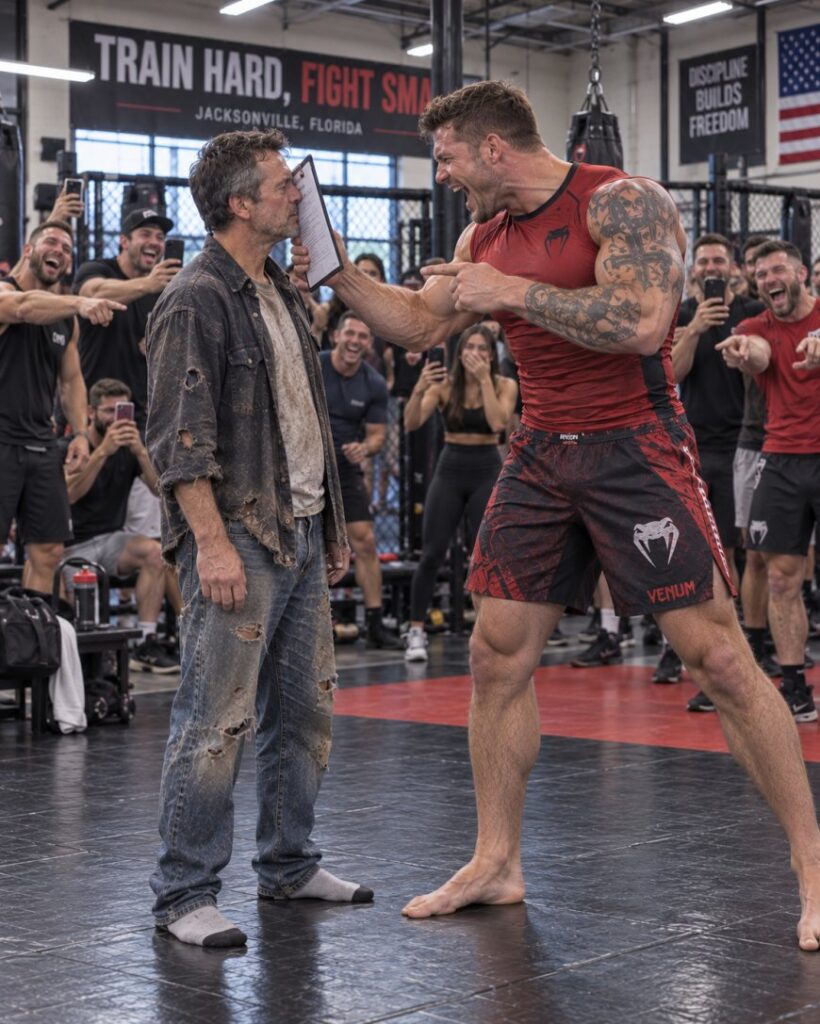
Bryce’s opening combination was a straight right hand followed by a low kick aimed at my lead thigh — the kind of entry that disrupts a man’s base and opens the next sequence.
Anatomy
The right hand passed through empty space.
I had tilted my head by no more than four inches at exactly the right moment, and the kick met a raised shin rather than soft tissue. The bones connected with a sound like a bat on hardwood, and Bryce’s expression shifted for the first time. Not pain, exactly, but the unwanted recognition that the kick had cost him something, and the man across from him had not moved his feet.
What followed for the next several minutes was the part of the evening that people who posted clips online would later have difficulty explaining.
Bryce continued attacking — cycling through his offense with genuine technical quality. Hooks, low kicks, level changes, a feint sequence he used effectively in competition. None of it landed with anything meaningful. My defensive movement was almost insultingly small. A shoulder roll here, a slight rotation there, a rear step timed so precisely that Bryce’s best punch arrived at a position my head had already vacated.
I didn’t counter. I didn’t gesture to the crowd or say anything. I simply made his combinations disappear one after another, as if the choreography of the attack had been shared with me in advance.
Translation Tools & Resources
The room understood gradually and without anyone announcing it that something was wrong with the math of what they were watching.
Bryce felt it before he could name it. His breathing was heavier than it should have been for the time elapsed. His feet were slightly less precise than at the start. The man in front of him had absorbed every attempt without visible fatigue and had not yet thrown a single offensive strike. That last detail had started eating at his concentration because a man who isn’t throwing back is either afraid or he’s waiting — and the man in front of him was visibly not afraid.
Bryce committed to a left hook with full body weight behind it — a knockout-oriented strike he kept in reserve for moments when he needed to reset an opponent’s confidence.
I caught his wrist out of the air.
Not deflected. Not redirected. Caught the way you catch something thrown to you that you expected to arrive. Bryce pulled. His arm did not come back. The grip around his wrist belonged to a different category of human strength than he had prepared for, and the recognition settled over him like cold water.
I held him there long enough that the entire room understood the position. Then I spoke — not loudly, directly, at the level of a man reading findings from a report.
I told him his right shoulder dropped a half second before every significant strike. I told him he held his breath when he entered the pocket. I told him his eyes always fixed on the target before the technique was initiated, removing any element of deception.
And then I said the one thing that landed in the room like a stone dropped into still water: he was fighting for the people watching, not for the man in front of him. And that was a losing condition, regardless of skill level.
I released his wrist and pushed him back two steps.
The gym was absolutely silent — not the silence of boredom, but of people recalibrating everything they had come to see. Bryce’s face moved through several expressions quickly before settling on something cold and deliberate.
He called for a switch to grappling, announcing to the room that this was his domain, that whatever the older man had was about to run out on the ground. He shot a double leg takedown with real speed — genuinely good technique, the kind that works against prepared opponents in competition.
I sprawled, hips dropping with a precision that suggested the movement had been executed thousands of times, and the takedown collapsed. I secured wrist control, used the momentum to bring Bryce to the mat, and locked his arm in a position that was one small adjustment away from serious joint damage.
I held it there. Bryce’s muscles corded against the hold. Nothing moved.
I spoke close to the side of his head with the same level tone I’d used all evening. I told him that what he had been telling these children — that strength gave a person the right to cause pain to someone smaller — was not martial arts. It was not discipline. It was not instruction.
And then, before the arm reached the angle where real damage would begin, I let go and stood up and took two steps back.
Being released was worse than being submitted. Bryce understood that in the way a person understands a humiliation delivered with complete control — not in heat, but as a deliberate choice. The man had stopped him from the inside out, shown every flaw in his game to a room full of his own students, and then extended courtesy he hadn’t earned.
Bryce got up with the fury of someone who has exhausted his technical options and decided to find a different kind of solution.
He suggested, reasonably, that I should put gloves on for fairness. When I turned toward the equipment shelf, Bryce launched a kick at the back of my head with everything he had.
The intent was unmistakable.
I caught the motion in my peripheral field and rotated, and the kick clipped my shoulder instead of its target, spinning me off balance and sending a visible shudder through the crowd. Several parents started talking loudly. One man near the door said it was time to call this off.
Bryce did not stop.





