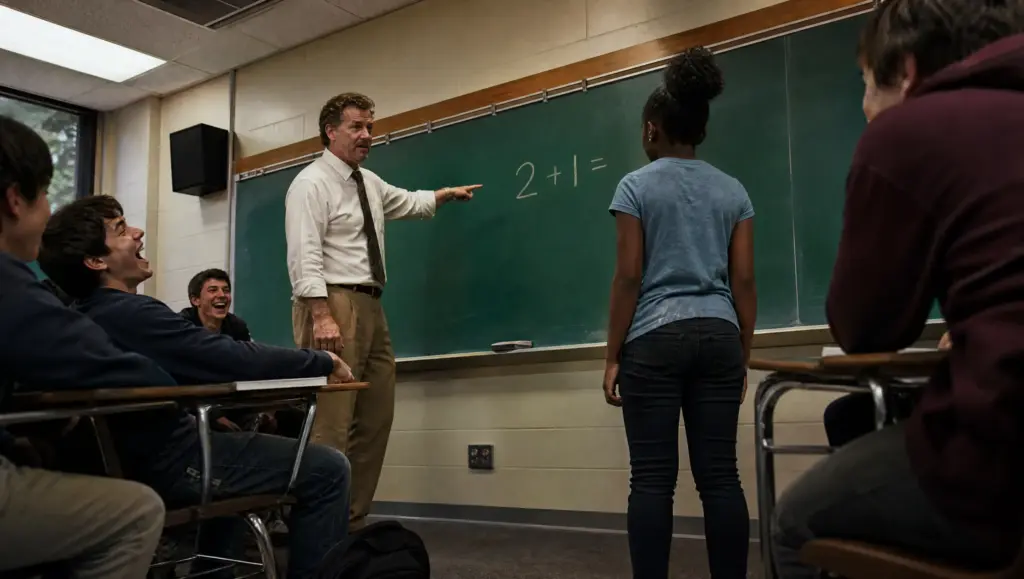
The Equation That Exposed a Secret
No real solution.
Imani Quartey drew a careful oval around those three words.
For a moment, Room 214 was silent.
Then Cole Brennan laughed.
“Congratulations. You proved you can’t solve it.”
A few students joined him.
Imani kept her eyes on the board.
“No,” she said. “I proved that the equation, as written, has no solution in the real numbers.”
Mr. Ellery approached the board.
He examined her work without speaking.
One minute passed.
Then another.
Imani could hear the clock above the classroom door ticking.
Finally, Mr. Ellery picked up the chalk.
“You’ve made an assumption.”
Imani turned.
“Which one?”
He pointed toward the final line.
“That the problem is supposed to have a real solution.”
Imani frowned.
“This is a pre-algebra class. You said the answer would be a real number.”
Several students nodded.
Mr. Ellery’s expression tightened.
“Are you questioning my teaching?”
“I’m questioning the equation.”
“There’s a difference?”
“Yes, sir.”
Something changed in the room.
The students were no longer laughing.
Mr. Ellery placed the chalk down.
“Sit down, Imani.”
“But I haven’t finished explaining.”
“Now.”
Imani stared at him.
Then quietly returned to her desk.
She had expected him to correct the sign.
Perhaps even thank her.
Instead, he opened his gradebook.
“Since Miss Quartey is so confident in her mathematical abilities, perhaps she can explain why she received only seventy-eight percent on last week’s assessment.”
Imani felt her face grow warm.
“Because you marked three of my answers incorrect.”
“And were they?”
“No, sir.”
Cole whispered something.
This time, nobody laughed.
Mr. Ellery closed the gradebook.
“Then I suggest you spend more time studying and less time trying to embarrass your teachers.”
Imani looked down at her hands.
She had been wrong about something.
Not the mathematics.
She had been wrong to believe that proving the answer would settle the argument.
That evening, Imani sat at the kitchen table while her mother, Dr. Ama Quartey, prepared dinner.
The apartment smelled of onions, ginger, and the rice warming on the stove.
Ama worked long shifts as a hospital pharmacist. She was tired, but she noticed immediately that her daughter hadn’t opened her favorite astronomy book.
“Something happened.”
Imani shrugged.
“Math.”
Ama turned off the stove.
“Tell me.”
Imani described the equation.
The missing negative sign.
The laughter.
The gradebook.
And the way Mr. Ellery had looked at her when she refused to pretend she was wrong.
Ama listened without interrupting.
When Imani finished, her mother asked, “Do you still have your work?”
Imani opened her purple backpack.
She removed a notebook filled with carefully written equations.
Ama examined the pages.
She wasn’t a mathematician, but she knew enough algebra to follow the central argument.
“Did he explain where your reasoning failed?”
“No.”
“Did he offer a different solution?”
“No.”
Ama closed the notebook.
“Then tomorrow, we’ll ask him to.”
Imani looked alarmed.
“Mom, please don’t.”
“Why?”
“He already thinks I’m difficult.”
Ama pulled out a chair.
“Imani, being mistaken is not the same as being difficult. And asking someone to explain their reasoning isn’t disrespectful.”
Imani stared at the table.
“What if he’s angry?”
Ama considered the question.
“Then we will remain polite. And we will keep asking for an explanation.”
She pushed the notebook back toward her daughter.
“But first, I want you to check every line again.”
Imani looked surprised.
“You think I’m wrong?”
“I think you’re responsible for making sure you’re right.”
For the first time that evening, Imani smiled.
The following morning, Room 214 had a visitor.
Dean Harriet Wexler stood near the windows, holding a slim leather folder.
She was a tall woman with silver hair and a reputation for remembering everything students wished she would forget.
Mr. Ellery greeted the class with unusual enthusiasm.
“Today, we’re going to discuss mathematical reasoning.”
Imani opened her notebook.
She noticed that yesterday’s equation had been erased.
Completely.
Even the faded fractions in the corner were gone.
Mr. Ellery wrote a new problem on the board.
This one was straightforward.
Several students solved it within minutes.
Then Dean Wexler spoke.
“Before we continue, I’d like to address a concern brought to my office.”
Imani’s stomach tightened.
Mr. Ellery’s smile became fixed.
The dean turned toward the class.
“Yesterday, a student challenged a mathematical expression. I’ve reviewed the written work.”
She paused.
“The student’s reasoning was correct.”
A murmur spread across the classroom.
Cole sat upright.
Mr. Ellery cleared his throat.
“With respect, Dean Wexler, the problem was intentionally designed to encourage discussion.”
“That may have been your intention,” she replied. “But the issue is whether the student was treated fairly after identifying the error.”
Mr. Ellery said nothing.
Dean Wexler opened her folder.
“And there’s another matter.”
She removed three examination papers.
Imani recognized the purple ink immediately.
Her assessment.
The one marked seventy-eight percent.
The dean placed it on the desk.
“I asked another mathematics instructor to review these answers without seeing the original grades.”
Mr. Ellery’s face lost some color.
“The review found that three correct solutions had been marked incorrect.”
Imani stopped breathing for a moment.
Dean Wexler continued.
“Her revised score is ninety-six percent.”
The classroom erupted.
“Wait, what?”
“She got ninety-six?”
“How?”
Cole turned around.
Imani didn’t move.
She wasn’t smiling.
She was looking at Mr. Ellery.
Because something about his expression frightened her.
He didn’t look surprised.
He looked exposed.
At lunch, Lila Chen found Imani sitting alone beneath the oak tree near the science building.
“Can I sit?”
Imani nodded.
Lila opened her lunchbox.
“That was unbelievable.”
Imani stared at her sandwich.
“Which part?”
“The dean. Your test. Everything.”
Imani shrugged.
“I just wanted him to fix the equation.”
Lila hesitated.
Then lowered her voice.
“Imani, there’s something you should know.”
Imani looked up.
Lila glanced around.
“My brother had Mr. Ellery two years ago.”
“So?”
“He says this happened before.”
Imani frowned.
“What happened?”
“A student challenged one of his answers. Mr. Ellery said the student was being disruptive.”





