Before Eli Carter stepped through the gate at Harbor Field, he checked that the envelope was still inside his shirt.
The paper scratched against his ribs.
He almost turned around.
Beyond the fence, Derek Vaughn was laughing beneath a banner that read EVERY KID DESERVES A CHANCE.
Two professional teammates stood beside him while a camera operator filmed footage for his foundation.
Children carried signed baseballs toward the parking lot.
Eli had neither a wristband nor a baseball worth signing.
He had his father’s glove.
The brown leather had faded almost gray around the thumb, and ordinary shoelaces held the webbing together.
Inside the palm, two initials remained beneath years of sweat and dirt.
N.C.
That morning, Nolan Carter had caught Eli examining them at the kitchen table.
“Leather remembers,” his father had said.
“Remembers what?”
“Whatever you put into it.”
Nolan had reached across the table with his left hand.
His right shoulder never moved much before breakfast.
Sometimes Eli heard him standing beneath the hot shower long before sunrise, trying to loosen it before work.
“Keep your weight back,” Nolan added, watching Eli balance his chair on two legs.
“Let things come to you.”
It was something he said about baseball and almost everything else.
Now Eli stood outside a field where children with better shoes had spent the afternoon receiving instruction he couldn’t afford.
He touched the envelope again.
Then he walked through the gate.
“Hey,” a volunteer called.
“Clinic’s over.”
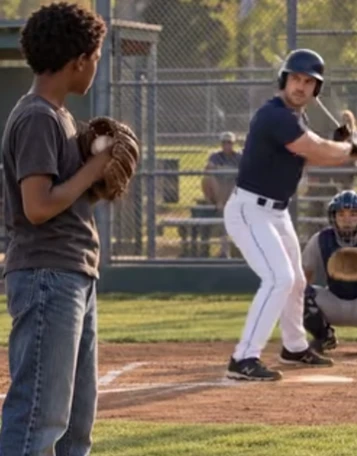
Eli kept moving until he was twenty feet from home plate.
“Derek Vaughn!
Let me throw one pitch!”
The superstar turned.
Up close, Derek looked larger than he did on television: broad shoulders beneath a navy training shirt, powerful forearms, a face Eli had seen on advertisements outside sporting-goods stores.
At thirty-six, he had three batting titles, two league MVP awards, and the easy confidence of a man accustomed to people making room.
His eyes moved over Eli’s faded shirt, loose jeans, and worn sneakers.
“Were you in the clinic?”
“No, sir.”
“Got a wristband?”
“No.”
Derek glanced toward the volunteer.
“Then what are you doing on my field?”
Eli’s mouth went dry.
“I just want one chance to pitch against you.”
One teammate snorted.
Derek looked at the glove pressed against Eli’s chest.
“With that piece of junk?
You couldn’t even throw across home plate.”
Laughter traveled along the fence.
A father lowered his phone long enough to grin.
Two younger boys stared at the shoelaces in Eli’s glove.
The camera operator shifted closer.
Eli felt the familiar heat rise into his face.
At school, he sometimes washed his baseball socks in a bathroom sink because the laundromat money had gone toward groceries.
Once, a classmate had photographed them drying beside his backpack.
He had learned that explaining yourself usually gave people more things to laugh at.
So he didn’t explain.
“Do you dare try hitting three pitches?”
Derek raised his eyebrows.
“Do I dare?”
“Come on, D,” his teammate said.
“Give the kid his funeral.”
Derek smiled toward the camera.
“All right.
Three pitches.
This should take ten seconds.”
Near the dugout, Ryan Lee stopped stacking equipment.
The twenty-one-year-old college catcher had volunteered all afternoon.
He had watched Derek patiently sign expensive bats and pose beside smiling donors.
He had also watched the star’s expression change whenever the cameras turned away.
Ryan picked up a mask.
“I’ll catch.”
Derek shrugged and reached for a wooden bat.
Eli walked toward the practice mound.
His sneakers sank slightly into the loose dirt.
For years, he had pitched against a square painted on the plywood wall behind his father’s maintenance shed.
Nolan marked the corners with blue chalk.
When Eli missed, his father never called him useless.
“Again,” he said.
When Eli hit the square, Nolan narrowed it.
Now there was a major-league hitter where the plywood should have been.
Derek tapped home plate.
“Let’s go, superstar.”
Eli tucked the ball behind his glove.
His fingers settled across the seams.
He turned his shoulder, paused for the smallest instant, and delivered.
Derek started his swing late.
The bat sliced through empty air.
POP.
Ryan caught the pitch low in the strike zone.
The laughter stopped.
“Lucky pitch!” someone called.
Derek rolled his shoulders.
“Cute.”
Halfway up the bleachers, seventy-one-year-old Walter Bell leaned forward so abruptly that his cane struck the aluminum bench.
He had been a celebrated championship coach long before Derek became famous.
His photograph hung in the Harbor Field clubhouse.
That afternoon, he had been introduced as the foundation’s honorary baseball adviser.
He stared at Eli’s glove.
Then at his shoulder.
“No,” Walter whispered.
Ryan threw the ball back.
Eli caught it and rubbed his thumb along a seam.
His heartbeat was loud, but his hands were steady.
Derek planted his feet more carefully.
The second pitch left Eli’s hand looking slower.
Derek saw something he could punish.
He committed his weight, drove the barrel forward—and the ball broke away from the path he had chosen.
Another miss.
Ryan’s mitt closed.
This time, the silence spread all the way to the parking lot.
Derek turned.
“Was that a strike?”
“Yes,” Ryan answered.
Derek looked back at the mound.
His smile had disappeared.
Spectators raised their phones.
The camera operator moved behind the backstop.
Derek stepped out of the batter’s box.
“Your luck ends now.”
Eli’s fingers tightened around the returned baseball.
“That’s exactly what my dad told you in that championship game.”
Derek went still.
Walter stood.
The name came to Derek before the memory fully formed.
A humid night in Birmingham.
Scouts behind home plate.
Two outs in the ninth inning.
Bases loaded.
A skinny pitcher with a glove held together by mismatched leather strips.
“Nolan,” Derek said.
Eli lowered the glove enough to expose the palm.
The initials were still there.
For a moment, Derek heard the old stadium crowd instead of the people at Harbor Field.
He remembered the third pitch most clearly.
Then a different sound: a hard impact beneath the concrete bleachers.





