Whitmore University sat on forty acres of manicured, emerald-green lawns in the heart of Philadelphia. Ivy climbed the towering Gothic stone walls like veins of old prestige. Bronze statues of long-dead scholars lined the courtyards, their hollow eyes watching generations of the elite pass beneath them. The mathematics department alone had produced three Fields Medal nominees in the last decade. Every echoing hallway smelled of old money, rich mahogany, and fresh, unbridled ambition.
Andre Powell had never set foot inside those hallowed hallways through the front door.
His mother, Denise, had worked the night janitorial shift at Whitmore for six grueling years. She clocked in at 9:00 PM and clocked out at 5:00 in the morning. Night after night, she scrubbed scuffed floors, emptied overflowing trash cans, and sanitized bathrooms that entitled students had wrecked over the weekend. Her hands, once soft, were now rough enough to sand wood, permanently stained with the harsh chemicals she used to polish the brass doorknobs of the faculty lounge. She earned exactly $11.60 an hour.
Andre came with her most nights. It wasn’t because he wanted to, but because there was simply nowhere else to go. Their cramped, one-bedroom apartment on the other side of the city had no heat after ten o’clock in the winter, and the neighborhood was too dangerous for a young boy to navigate alone in the dark.
But the university at midnight was a different world. It had warm, radiator-heated hallways, bright fluorescent lights, and something else that saved Andre’s life: books.
Thousands of them. They were left behind on empty desks, shoved haphazardly into recycling bins, or forgotten on the plush seats of the lecture halls. Andre started reading them when he was eight years old. While his mother pushed a heavy mop down the corridors, Andre sat cross-legged in the back of empty classrooms, devourering discarded knowledge. By nine, he had finished every introductory calculus textbook the trash cans had to offer. By ten, he was working his way through advanced linear algebra. By eleven, differential equations and multivariable calculus were second nature to him.
He never told anyone. He never asked for a tutor or raised his hand. He just read, and solved, and read some more. To Andre, the world was chaotic, cruel, and unfair. But mathematics was pure. Numbers didn’t care how much money your mother made, or the color of your skin, or the zip code of your apartment. In mathematics, there was only truth.
By the time Andre was sixteen, his secret brilliance could no longer be contained. A high school guidance counselor had discovered his notebooks, leading to a battery of tests that shattered state records. Within months, Andre was offered a full-ride academic scholarship to Whitmore University.
But walking through the front door as an official student didn’t mean he belonged—not in the eyes of the establishment.
Professor Arthur Sinclair was the reigning tyrant of Whitmore’s mathematics department. A tenured, third-generation Ivy Leaguer, Sinclair wore tweed jackets, drove a vintage Jaguar, and harbored a deep, venomous resentment for the changing demographics of “his” university. He believed genius was inherited through blood and bank accounts, not cultivated in the slums.
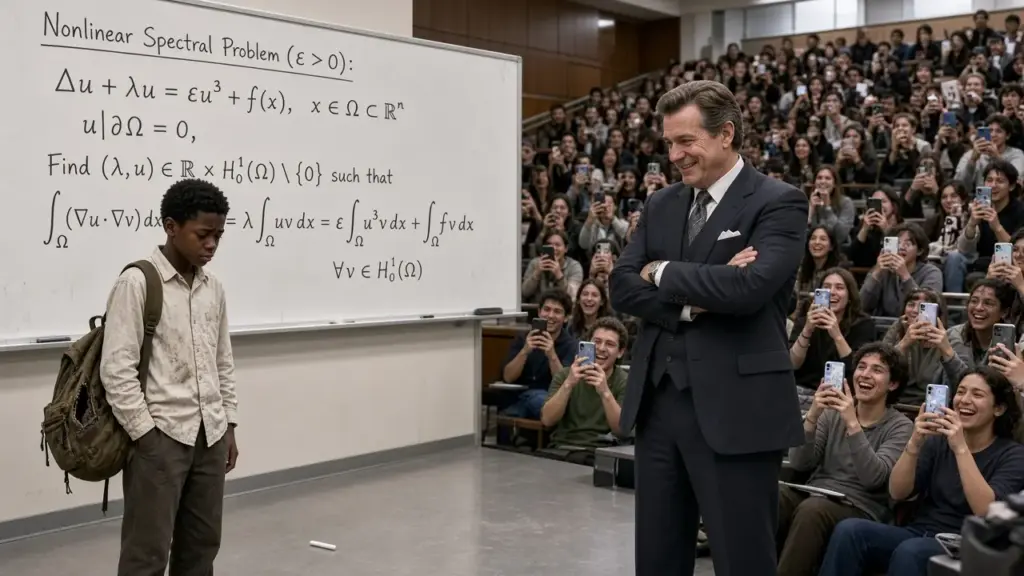
It was the third week of the fall semester in Advanced Number Theory. The tiered lecture hall was packed with two hundred affluent students staring down at Sinclair, who stood by the massive slate chalkboard like a king holding court.
Andre had arrived a few minutes late, his battered backpack slung over his shoulder, wearing a faded thrift-store hoodie that stood out aggressively against a sea of designer sweaters and expensive watches. As he quietly tried to slip into an empty seat in the second row, Sinclair stopped speaking.
The silence in the room became sharp and immediate. Sinclair turned his pale, icy eyes on the teenager.
“Who let this thing into my classroom?” Sinclair’s voice boomed through the amphitheater, dripping with raw, unfiltered contempt.
Andre froze, his hand resting on the back of a wooden chair. “Please, I just wanted to find a seat—”
“Get out,” Sinclair snapped, waving his hand as if swatting away a fly. “You should go help your mother clean the toilets. Or your father, wherever he might be. This is a university, not a charity shelter.”
A ripple of uncomfortable, cruel laughter echoed from the back rows. Several students pulled out their smartphones, the camera lenses gleaming under the fluorescent lights as they began to record the confrontation.
Andre didn’t lower his head. He didn’t shrink away. He looked directly into the professor’s eyes, his voice steady and calm. “I am enrolled in this class, Professor. And mathematics doesn’t discriminate.”
Sinclair’s face flushed a deep, ugly crimson. His lip curled into a vicious sneer. “Then prove it to me.”
The professor spun around, grabbed a piece of thick white chalk, and began violently attacking the blackboard. He scrawled a sprawling, nightmarish equation across the slate. It was a notoriously brutal derivation of the Riemann zeta function, laced with complex topological variables and non-linear partial derivatives. It was a graduate-level trap, designed specifically to be unsolvable without pages of reference material and hours of computation.
Sinclair stepped back, tossing the chalk onto the metal tray with a sharp clatter.
“Solve this,” Sinclair challenged, crossing his arms over his tweed chest. “I’ll give you an A for the entire semester right now. Go ahead. Show me what the janitor’s little son can do.”
More laughter echoed through the hall. Flashlights blinked as phones recorded every second.
“A bunch of stinking Black idiots,” Sinclair muttered under his breath, though his microphone caught the vile edge of his voice, amplifying it just enough to be heard by the front rows. “This is going to be hilarious.”
Sinclair folded his arms, still grinning a predatory, wolfish grin. He expected the boy to stare blankly at the board, to cry, to apologize, or to run out of the room in shame.
His name was Andre Powell. And he didn’t leave.





