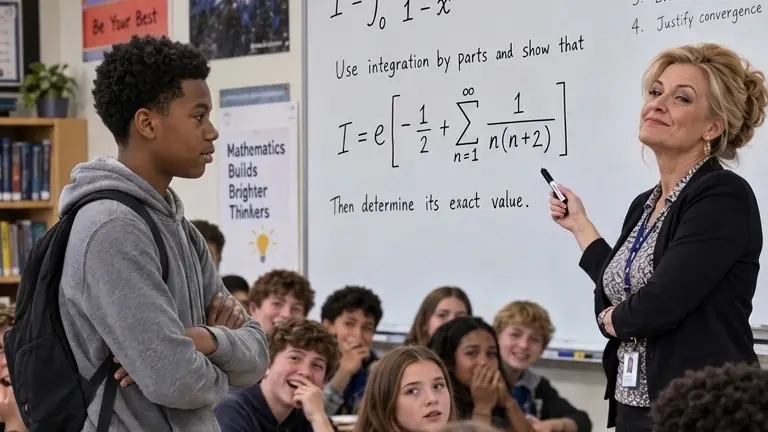
She turned sharply on her heel, her low heels clicking aggressively against the linoleum as she marched toward the massive chalkboard spanning the front wall.
“This,” she announced with a cruel, tight-lipped smile, grabbing a fresh piece of chalk, “is a calculus problem I am preparing for my eleventh-grade Advanced Placement class. Since you clearly feel that our seventh-grade curriculum is beneath you—so much so that you refuse to even sit in the chair provided for you—you can stand up here and solve it.”
She began to write, the chalk squeaking violently against the slate. She didn’t just write a standard calculus problem; she constructed a nightmare. It was a complex second-order non-homogeneous differential equation, intertwined with a brutal trigonometric integration. It was designed not just to stump a middle schooler, but to completely humiliate him.
The class watched in terrified silence. Most of them didn’t even recognize the symbols. To them, it looked like an alien language.
“Well?” Veronica Maxwell sneered, stepping back and tossing the chalk onto the metal tray. It rattled loudly in the quiet room. “Come on up, Thompson. Let’s see this special brilliance of yours. Or you can sit down right now, accept a week of detention for your insubordination, and apologize to me.”
Thompson stood frozen by his desk. His heart hammered wildly against his ribs. The pain in his back was a constant, burning throb. Just four days ago, after he had slumped forward on his desk in exhaustion, Ms. Maxwell had called him to the front. Under the guise of correcting his posture, she had brought a thick, wooden yardstick down across his shoulder blades with terrifying force. She had done it in the coat closet, out of sight of the other students, whispering that if he ever told anyone, she would ensure he was expelled for attacking a teacher.
He hadn’t told his parents. He hadn’t told the principal. He had just suffered in silence, burying himself in the only thing that made sense to him: numbers.
Slowly, Thompson released his death grip on his backpack, letting it slide onto his chair.
“I’ll try,” he whispered.
“Speak up!” she barked.
“I said, I will try, Ms. Maxwell.”
Every eye in the room was fixed on him as he walked down the aisle. His steps were stiff and measured. When he reached the front, he winced visibly, a sharp intake of breath escaping his lips as he reached down to pick up the chalk. The movement stretched the bruised, inflamed muscles across his back, sending a shockwave of agony down his spine.
Veronica crossed her arms, her face a mask of triumphant malice. She waited for him to stare blankly at the board, to cry, to break.
Instead, Thompson looked at the chaotic web of numbers and variables. For a moment, the pain in his back faded, entirely eclipsed by the beautiful, perfect logic of mathematics. He didn’t see an impossible trap; he saw a puzzle. He saw the auxiliary equation. He saw the particular solution hiding behind the trigonometric identity.
Thompson raised his hand and began to write.
He didn’t pause to think. The chalk flew across the board in a flurry of white dust. He blew past the initial differentiation, effortlessly factoring the polynomial. He integrated the sine and cosine functions in his head, writing down the intermediate steps with a rapid, fluid grace that left the classroom breathless.
The smug, predatory smile on Ms. Maxwell’s face began to falter. She uncrossed her arms, taking a half-step forward. Her eyes darted across his work, searching frantically for a misplaced negative sign, a failed derivative, a dropped variable.
There was nothing. His math was flawless.
As Thompson reached the final phase of the equation, he needed more space. He stepped to the right and reached high up on the chalkboard to write the final, integrated function.
As he stretched his arm upward, the hem of his faded polo shirt pulled free from his waistband and rode up his back.
A collective gasp echoed through the classroom.
Sitting in the front row, a girl named Chloe covered her mouth with both hands. Even the kids in the back row could see it. Stretching horribly across the lower half of Thompson’s pale back was a massive, dark purple welt. The bruise was perfectly straight, an inch wide, and bordered by angry red, broken blood vessels. It was the unmistakable, geometric stamp of a wooden yardstick.
At that exact moment, the heavy wooden door to the classroom clicked open.
Principal David Harris stepped inside, carrying a clipboard. It was a routine, unannounced classroom observation—a standard procedure for the district. But as he stepped into the room, he didn’t see a teacher conducting a lesson.
He saw a classroom of horrified children staring at the front of the room. He saw Veronica Maxwell, pale as a ghost, staring in shock at the complex calculus on the board. And he saw a thirteen-year-old boy stretching to write an answer, his shirt lifted, exposing a horrific, violent injury on his back.
“Good God,” Principal Harris breathed.
Thompson, startled by the voice, flinched violently. He dropped the chalk and spun around, his shirt instantly falling back down to cover the bruise. He backed away from the board, his eyes wide with panic, pressing himself against the wall like a trapped animal.
The silence in the room was suffocating.
Principal Harris walked slowly to the front of the room. His eyes flicked to the chalkboard—taking in the impossibly advanced, perfectly solved eleventh-grade calculus problem—and then locked onto Thompson.
“Thompson,” Principal Harris said, his voice terrifyingly calm, the kind of calm that precedes a hurricane. “Who did that to you?”
Thompson looked at the floor, his entire body trembling. “I… I fell, Mr. Harris. I fell down the stairs.”
“That is not a bruise from a fall,” Harris said, stepping closer, his voice softening with a fatherly gentleness. “That is a strike mark. Someone hit you with a straight edge. Who was it?”





