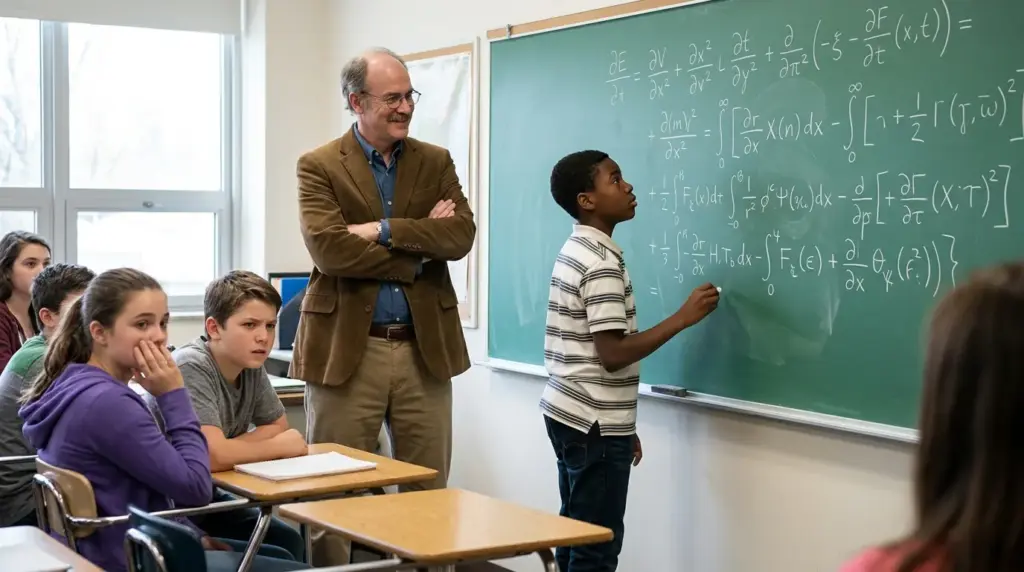
The afternoon sun filtered through the dusty windows of Roosevelt Middle School’s advanced mathematics classroom, casting long, geometric shadows across the worn wooden desks. The air in the room was stale, smelling faintly of floor wax, old paper, and the nervous sweat of thirty twelve-year-olds who felt they were constantly walking on eggshells.
At the front of the room stood Mr. Harold Wittmann. His half-bald head gleamed under the harsh, buzzing fluorescent lights as he surveyed his seventh-grade class with a look of barely concealed disdain. Mr. Wittmann had been teaching for thirty-two years, and over those three decades, he had developed a rigid, unyielding philosophy: he was the ultimate gatekeeper of intellect. In his mind, true genius was a rare commodity, one that certainly did not belong in a public middle school, and most definitely did not belong to the students sitting before him.
His gray mustache twitched with each dismissive glance, particularly when his eyes landed on Marcus Johnson.
Marcus was a quiet, unassuming twelve-year-old, and the only Black student in Mr. Wittmann’s advanced mathematics class. He had transferred to Roosevelt Middle School just two months prior, carrying a battered canvas backpack and a notebook filled with scrawled, illegible notes. Marcus never raised his hand to answer questions. He never engaged in the frantic, competitive hand-waving that the other students used to seek Mr. Wittmann’s rare approval. He simply sat in the third row, his dark eyes focused intensely on the blank pages of his notebook, absorbing everything in absolute silence.
To Mr. Wittmann, this silence was not just a sign of disrespect; it was an insult to his authority.
“Today, class,” Mr. Wittmann announced, his voice dripping with condescension, slicing through the heavy silence of the room. “We are going to explore something that will separate the truly gifted from those who… well, let’s just say, from those who are here by mistake.”
His gaze lingered pointedly on Marcus.
Sarah Chen, the class valedictorian and a girl who typically thrived under academic pressure, shifted uncomfortably in her seat in the front row. She had noticed how Mr. Wittmann always seemed to direct his harshest, most biting comments toward Marcus, despite the boy maintaining a solid, consistent B+ average on all his written exams.
Tommy Rodriguez, sitting at the desk adjacent to Marcus, clenched his jaw tightly. He liked Marcus. They ate lunch together sometimes. Tommy had learned the hard way that challenging Mr. Wittmann only made things worse, so he remained silent, though his stomach tied itself into anxious knots.
“I have prepared a special problem,” Mr. Wittmann continued, turning his back to the class and picking up a fresh piece of pristine white chalk. He began to write on the blackboard with exaggerated, theatrical flourishes. “A real mathematician’s challenge. Something that even tenured college professors might struggle with on a good day.”
The chalk squeaked aggressively against the slate. He wrote line after line, stepping back finally to reveal a sprawling, nightmarish complex differential equation. It was a terrifying maze of multiple variables, advanced integral symbols, partial derivatives, and nested functions that seemed to dance across the board in a chaotic web of mathematical complexity.
The classroom fell dead silent. Even Sarah, who usually tackled every single problem with a bright-eyed confidence, stared at the chalkboard with widening eyes, her pencil slipping from her grasp. This wasn’t just advanced for seventh grade; this was lightyears beyond high school calculus. It was postgraduate-level theoretical physics.
“Now,” Mr. Wittmann said, turning back to face his terrified students. His thin lips curled into what could only be described as a cruel, predatory smile. “I know most of you won’t even understand the symbols you are looking at. It is, frankly, beyond your limited cognitive capacities. But perhaps…”
He paused dramatically, allowing the tension in the room to build to a suffocating peak. His cold eyes found Marcus once again.
“Perhaps our Mr. Johnson would like to try. After all, affirmative action and school diversity quotas got you into this advanced class, didn’t they? We might as well see if you can actually justify your physical presence in my room.”
The temperature in the classroom seemed to plummet ten degrees. Several students gasped audibly, shocked by the blatant cruelty of the statement. Tommy’s hand instinctively moved across the aisle toward Marcus’s desk in a silent gesture of support, but Marcus remained perfectly still. His expression was entirely unreadable, an impenetrable fortress of calm.
“Did you hear me, boy?” Mr. Wittmann pressed, his voice echoing off the cinderblock walls, emboldened by the boy’s silence. He took a deliberate step away from the chalkboard, crossing his arms over his chest. “Or are you too busy struggling with basic fractions in your head to comprehend the words I am speaking?”
The silence grew agonizing. Sarah chewed nervously on her bottom lip, tasting copper. Tommy tightened his grip on his desk.
Marcus slowly lifted his head.
There was no anger in his dark eyes. There was no shame, no embarrassment, and absolutely no fear. Instead, there was a calm, piercing intelligence that seemed entirely out of place on the face of a twelve-year-old boy.
Interpreting Marcus’s silence as cowardice and intellectual paralysis, Mr. Wittmann doubled down on his mockery. He reached into his tweed blazer pocket, pulled out another piece of chalk, and tossed it underhand. It bounced off Marcus’s wooden desk with a sharp, echoing clack and rolled to a stop right against his notebook.
“You couldn’t solve a simple arithmetic problem if your life depended on it, Marcus,” the teacher sneered, his voice loud enough for the passing students in the hallway to hear. “But here is a challenge for you: solve this equation, right now, and my entire year’s salary is yours. I will write you a check today.”
Marcus looked down at the small cylinder of white chalk resting on his desk. Then, he looked up at the sprawling equation on the board.





