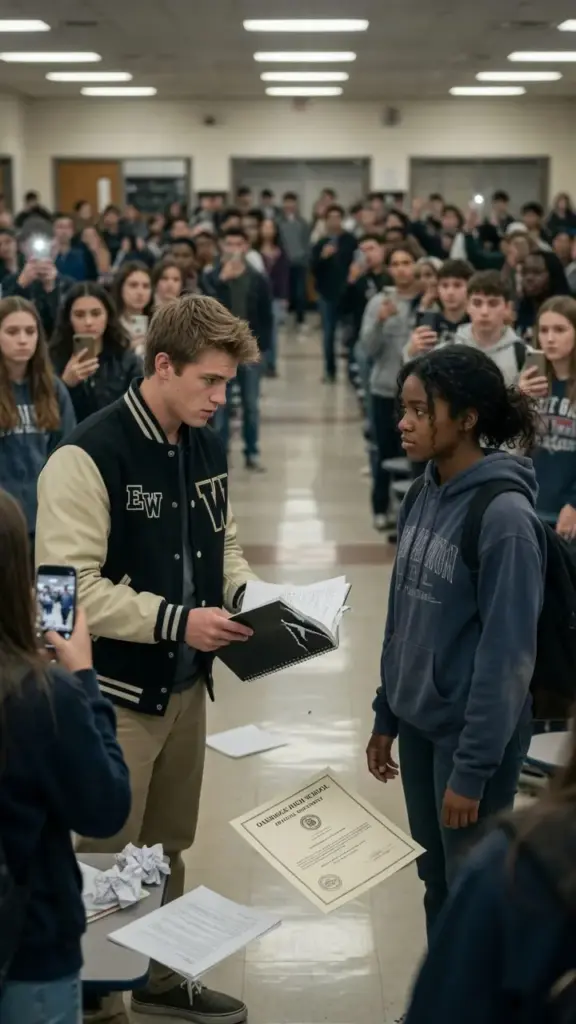
The School Bully Ripped a Quiet Girl’s Notebook Apart — Then the Principal Saw Her Father’s Name in a Reopened Case
Ethan Whitmore thought he was about to give the entire cafeteria something to laugh about.
He had no idea he was about to expose a secret his father had spent years trying to keep buried.
It happened during lunch at Roosevelt High School.
Naomi Carter, a quiet transfer student, was walking past Ethan’s table when he reached out and grabbed the worn black notebook she carried everywhere.
“What’s this?” he asked, grinning. “Your secret diary?”
Naomi stopped.
“Give it back.”
Ethan ignored her.
His friends leaned forward, expecting another entertaining humiliation.
He flipped through the pages.
Mathematics formulas.
Class notes.
Grocery reminders.
Then he laughed.
“You carry this thing around like it’s worth a million dollars.”
Naomi reached for it.
“Ethan. Please.”
He pulled it away.
And tore the notebook in half.
Loose pages scattered across the cafeteria floor.
Several students laughed.
Others stared.
But one sheet landed near a lunch table, faceup.
It was thicker than ordinary notebook paper.
Cream-colored.
Official-looking.
And stamped across the top in red were two words.
REOPENED CASE.
Ethan’s smile faded.
A teacher named Ms. Lane approached and picked up the document.
She read the first few lines.
Then her expression changed.
Principal Howard arrived moments later.
He examined the page.
And froze.
Because the name appearing in the old case file belonged to one of the town’s most influential attorneys.
Richard Whitmore.
Ethan’s father.
Naomi had attended Roosevelt High for only three weeks.
She wasn’t popular.
She wasn’t interested in becoming popular.
She kept to herself, completed her assignments, and usually spent lunch reading or reviewing notes.
Most students knew almost nothing about her.
They didn’t know that her mother had died.
They didn’t know she had moved several times before settling with her grandmother, Loretta Carter.
And they certainly didn’t know why she carried that battered notebook everywhere.
To Naomi, the notebook was more than a place for schoolwork.
It was where she kept fragments of a mystery that had followed her family for years.
Old dates.
Names.
Newspaper clippings.
Copies of documents.
And questions nobody seemed willing to answer.
Her grandmother had warned her to be careful.
“People don’t always get angry because you’re wrong,” Loretta once told her. “Sometimes they get angry because you’re close to something they don’t want found.”
Naomi had never forgotten those words.
Years earlier, a local officer named Daniel Brooks had raised concerns about irregularities in a criminal investigation.
A witness statement had disappeared.
An evidence record appeared to have been altered.
And important decisions had been made without clear explanations.
Daniel believed someone had interfered with the case.
He tried to bring the problem to light.
Then he died.
The investigation stalled.
People stopped asking questions.
But Daniel’s sister, Judge Elena Brooks, never accepted that the unanswered questions should simply disappear.
Neither did Loretta Carter.
Over the years, Loretta collected copies of records and old newspaper reports.
She stored them inside a lockbox hidden behind a loose panel in her apartment.
Naomi discovered the box while helping clean the hallway closet.
At first, the documents confused her.
Then she began noticing a name that appeared repeatedly.
Richard Whitmore.
A prominent attorney.
A generous political donor.
A man whose name appeared on scholarship banners and charitable plaques throughout town.
And the father of the boy who had just destroyed her notebook.
Inside Roosevelt High’s administrative conference room, Principal Howard placed the recovered document on the table.
Ms. Lane sat beside him.
Naomi occupied the chair opposite them, holding the remaining pages of her notebook against her chest.
“Naomi,” the principal began, “where did you get this?”
“My grandmother’s apartment.”
“Does she know you have it?”
“Yes.”
He studied the page again.
“Why did you bring it to school?”
Naomi looked down.
“Because I was trying to understand what happened.”
Principal Howard pointed to a line near the bottom.
Richard Whitmore’s name appeared beside a notation indicating that he had been consulted during the original review of evidence.
It wasn’t proof of wrongdoing by itself.
But it was significant.
And the principal seemed to recognize its importance.
“Do you understand how serious these documents could be?” he asked.
Naomi nodded.
“That’s why I didn’t want anyone touching them.”
Ms. Lane glanced at the torn notebook.
For the first time, she seemed to understand that Ethan’s actions had caused more than ordinary classroom damage.
Principal Howard reached for his telephone.
“I’m going to contact Judge Brooks.”
Naomi felt her stomach tighten.
She had spent weeks studying the records.
Now, suddenly, the person most closely connected to the old investigation was about to see them.
Judge Elena Brooks arrived at the school shortly afterward.
She wore a charcoal suit and carried herself with the composure of someone accustomed to difficult conversations.
She greeted Principal Howard.
Then turned toward Naomi.
“Your grandmother is Loretta Carter?”
“Yes, ma’am.”
The judge’s expression softened.
“Your grandmother believed my brother when very few people did.”
Naomi looked up.
“You knew she had the documents?”
“I knew she had kept records. I didn’t know exactly what survived.”
Judge Brooks sat down and examined the recovered pages.
She studied the case number.
The dates.
The signatures.
Then she stopped at a handwritten notation near the bottom of one page.
Her eyes narrowed.
She read it again.
“That’s interesting.”
Principal Howard leaned forward.
“What is it?”
The judge pointed to the entry.
“Richard Whitmore previously stated that he became involved only after the initial evidence review.”
She tapped the document.
“This notation places him in consultation earlier.”
The room became quiet.
Naomi looked from the page to the judge.
“Does that mean he lied?”
“It means there is a discrepancy that needs to be investigated,” Judge Brooks answered. “And this document may help establish what actually happened.”
For years, the surviving records had been incomplete.
Now an old copy had surfaced.





