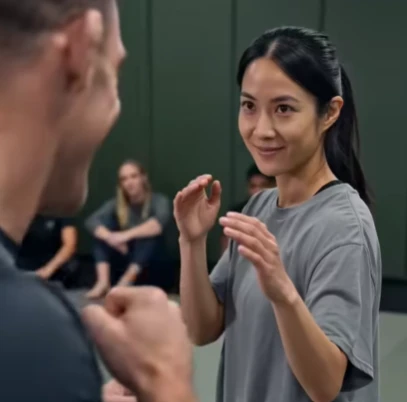
He Laughed and Said, “This Might Be Too Fast for You” — Moments Later, He Couldn’t Escape Her Hold
Evan Cole had never been particularly good at losing. At twenty-eight, the Brazilian jiu-jitsu black belt had collected championship medals, defeated experienced competitors, and developed a reputation for overwhelming opponents before they could settle into a rhythm.
So when a forty-two-year-old woman walked into Harbor Point Martial Arts wearing a plain gray rash guard, he saw an opportunity to impress his students.
Rachel Monroe hadn’t challenged him. She hadn’t mentioned her experience or claimed she could beat anyone. She had simply arrived asking to speak with the academy’s owner.
But Evan insisted on a demonstration.
“This might be too fast for you,” he joked as nearly thirty students gathered around the mat.
Rachel gave him a small smile.
“That’s possible.”
Coach Anthony Reed reluctantly agreed to supervise a one-minute technical round.
The timer started.
Evan attacked immediately, reaching for Rachel’s wrists and changing angles with the explosive speed that had made him a regional champion.
Rachel didn’t retreat. She calmly cleared his grips, adjusted her position, and let him waste energy trying to force an opening.
Evan frowned.
He increased his pace.
Rachel remained composed.
Then he shot forward, attempting to secure a takedown.
For a split second, he believed he had her.
But Rachel redirected his momentum, turned through the exchange, and brought him onto the mat with startling precision.
Before Evan could establish his bearings, she had moved behind him.
One hook secured.
Then the second.
Her arms settled into position, controlling his upper body while her legs prevented him from turning free.
Evan exploded into an escape.
Nothing.
He tried again, shifting his hips and reaching for her controlling arm.
Rachel adjusted without hesitation.
The students leaned closer.
Their champion was trapped.
“Thirty seconds,” Anthony announced.
Evan strained harder.
Rachel’s breathing remained steady.
He attempted to roll, but she followed the movement and maintained control.
Then she transitioned into a tight submission hold.
Evan recognized the danger immediately.
He tapped.
Rachel released him at once.
The timer showed forty-seven seconds.
For a moment, nobody spoke.
Evan sat upright, breathing heavily.
Rachel extended her hand.
“Good movement,” she said.
He stared at her.
“You weren’t even trying.”
“I was trying,” Rachel replied. “Just not trying to go faster than you.”
A few students exchanged surprised looks.
Evan stood, visibly embarrassed.
“Who exactly are you?”
Before Rachel could answer, Anthony stepped forward.
“She’s the instructor I invited to evaluate our advanced grappling program.”
Evan turned toward him.
“What?”
Anthony nodded.
“Rachel has spent more than twenty years training and teaching. She’s coached national-level competitors, developed technical programs, and helped experienced athletes correct problems they didn’t realize they had.”
Evan looked back at her.
“You could’ve told me.”
Rachel tilted her head.
“Would you have listened?”
The question silenced him.
Anthony folded his arms.
“Evan, you spent the last ten minutes explaining how fast you are. She spent forty-seven seconds showing you why speed isn’t everything.”
Rachel stepped toward the center of the mat.
“Your speed is excellent,” she told Evan. “But you keep moving even when movement isn’t helping you. You’re so focused on creating pressure that you don’t notice when someone is using it against you.”
Evan looked down.
He wanted to argue.
But he couldn’t.
Every escape he had attempted had made Rachel’s control stronger.
Every burst of energy had created another opening.
And the woman he had underestimated hadn’t needed to overpower him once.
“Can you show me where I went wrong?” he finally asked.
Rachel smiled.
“Of course.”
The students watched as the two returned to the mat.
This time, Evan wasn’t performing for an audience.
He was listening.
Rachel demonstrated how his rushed entries exposed his balance, how his reactions became predictable, and how a patient opponent could capitalize on the smallest mistakes.
She corrected his positioning without mocking him.
She praised the movements he executed well.
And when he finally escaped one of her controlled holds, she nodded approvingly.
“That’s better.”
Evan smiled for the first time since the round ended.
Over the following weeks, Rachel continued working with Harbor Point’s advanced students. Evan attended every session.
His technique improved, but something more important changed.
He stopped treating inexperienced students like obstacles to his reputation. He began asking questions instead of making assumptions. And when someone struggled, he remembered how it felt to be trapped by a person he had dismissed before the round even started.
Months later, a new student approached Evan after class.
“Coach, do you think I’m too slow for jiu-jitsu?”
Evan paused.
He remembered a woman in a gray rash guard, a one-minute round, and forty-seven seconds that had completely changed his understanding of the sport.
Then he smiled.
“Speed helps,” he said. “But learning when not to rush might help you even more.”
Across the academy, Rachel heard the exchange.
She didn’t interrupt.
She simply returned to teaching.
Evan never forgot the day he tried to impress thirty students by overwhelming a quiet visitor.
He had expected to demonstrate his superiority.
Instead, he discovered the limits of his own approach.
And the most valuable thing Rachel gave him wasn’t a defeat. It was the realization that experience doesn’t always announce itself, and real mastery often looks effortless to people who haven’t yet learned what they’re seeing.
Disclaimer: This is a fictional story created for entertainment purposes.





