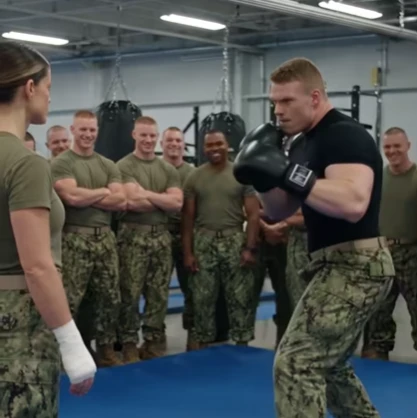
The Soldiers Laughed When a Quiet Woman Faced Their Strongest Fighter — Then One Punch Changed Everything
“Come on, sweetheart. At least put your hands up.”
The large soldier grinned as he raised his boxing gloves.
Around the training mat, nearly twenty soldiers burst into laughter.
Across from him stood a woman named Carter.
She wore a plain black training shirt, dark athletic pants, and an expression so calm that it seemed almost out of place in the noisy military gym.
She was smaller than the man facing her.
She wasn’t flexing her muscles.
She wasn’t trying to impress anyone.
And she hadn’t even raised her fists.
The soldier shook his head.
“You know this is a combat training facility, right? Not a yoga class.”
More laughter.
Carter glanced at him.
“I know where I am.”
“Then show me something.”
He stepped forward.
Without warning, his right fist shot toward her face.
Several soldiers leaned closer, expecting her to stumble backward.
Instead, Carter shifted her head a few inches.
The glove passed harmlessly beside her cheek.
No block.
No counterpunch.
No dramatic escape.
Just one small movement.
The soldier froze.
Carter looked at him.
“That all you’ve got?”
The laughter disappeared.
At the edge of the mat, an older officer who had been watching quietly straightened.
He had noticed something the others hadn’t.
Carter hadn’t reacted out of panic.
She had read the punch before it arrived.
“Again,” the officer said.
The soldier frowned.
“Sir?”
“Throw another punch.”
The larger man smirked.
“Gladly.”
This time, he approached more carefully.
He circled left.
Then right.
Carter barely moved.
He suddenly stepped forward, trying to pressure her toward the edge of the mat.
She adjusted her distance with a single controlled step.
His frustration grew.
“Stop running.”
“I’m standing right here,” she replied.
A few soldiers exchanged nervous glances.
The man attacked again.
A quick jab.
Carter slipped outside it.
A second punch followed.
She moved just far enough to avoid it.
He threw a third.
She stepped aside.
Three punches.
Three misses.
Not once had Carter attempted to strike him.
The soldier lowered his gloves, breathing harder.
“What is this?”
The older officer finally stepped onto the mat.
“That’s enough, Sergeant.”
The soldier turned.
“Sir, I haven’t even touched her.”
“I noticed.”
A few soldiers tried not to smile.
But the officer wasn’t amused.
He looked at Carter.
Then back at the sergeant.
“Do you know why she hasn’t hit you?”
The soldier shrugged.
“Because she can’t?”
The officer’s expression hardened.
“No. Because she isn’t here to fight you.”
The room became quiet.
Carter folded her arms.
The officer continued.
“She came here to evaluate our close-quarters combat training.”
The sergeant blinked.
“Evaluate?”
“Yes.”
The officer turned toward the surrounding soldiers.
“This is Chief Warrant Officer Carter. She’s spent years developing defensive tactics programs for military personnel.”
The sergeant stared at her.
Carter said nothing.
The officer continued.
“She has trained instructors, evaluated combat readiness, and helped identify weaknesses in training methods used by units much more experienced than ours.”
One of the younger soldiers whispered, “You’re kidding.”
The officer looked directly at him.
“I’m not.”
The sergeant’s face began turning red.
“But she didn’t introduce herself.”
Carter finally spoke.
“I wasn’t given much of a chance.”
Nobody laughed.
The sergeant remembered how the encounter had started.
He had seen her standing near the training area.
He had assumed she was a visitor.
Then he had challenged her in front of everyone.
When she declined, he had mocked her.
And when she finally stepped onto the mat, he had treated her like an easy target.
Now he understood why the older officer had been watching so closely.
Carter wasn’t trying to win a fight.
She was observing how the soldiers behaved under pressure.
And the results weren’t encouraging.
The officer turned toward her.
“What did you see?”
Carter looked around the gym.
“Good physical conditioning. Strong athletes. Plenty of confidence.”
The sergeant straightened slightly.
Then she continued.
“But some serious problems.”
The room fell silent again.
“Your soldiers confuse aggression with control. They attack without assessing distance, overcommit their weight, and become frustrated when an opponent doesn’t respond the way they expect.”
She looked toward the sergeant.
“You’re strong. Your punches have power.”
He nodded cautiously.
“But you telegraph your attacks.”
His expression changed.
“You raise your shoulder before throwing your right hand. You shift your weight too early. And when the first punch misses, you immediately try to force the next exchange.”
The sergeant looked down.
Carter continued.
“Your biggest weakness isn’t your technique.”
“What is it?”
“You stop thinking when your pride gets involved.”
The words landed harder than any punch.
The older officer nodded.
“That’s exactly what I saw.”
Carter stepped toward the center of the mat.
“Strength matters. Speed matters. Technique matters. But none of those things replace judgment.”
She glanced around the group.
“Who wants to learn something?”
For several seconds, nobody moved.
Then the same sergeant raised his hand.
“I do, ma’am.”
Carter studied him.
“Good. Come here.”
He stepped forward, this time without smiling.
She demonstrated how to maintain distance, recognize an opponent’s movement, and avoid wasting energy on unnecessary reactions.
The sergeant followed carefully.
When he made a mistake, she corrected him.
When he improved, she acknowledged it.
There was no humiliation.
No revenge.
No attempt to prove she was superior.
Only instruction.
After twenty minutes, the difference was obvious.
The sergeant’s movements became more controlled.
His shoulders relaxed.
He stopped chasing every opening.
And for the first time that afternoon, he began listening more than talking.
Carter stepped back.
“Better.”
The sergeant exhaled.
“Thank you, ma’am.”
She nodded.
“Remember how that feels.”
Later, after the session ended, the sergeant approached Carter near the equipment racks.
“Ma’am?”
She turned.
“Yes?”
“I owe you an apology.”
She waited.
“I treated you like you didn’t belong here. I made jokes. I tried to embarrass you.”
He glanced toward the empty mat.





