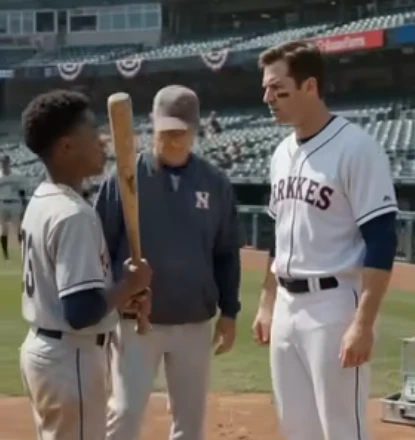
The Superstar Bet $20,000 That a Black Ball Boy Couldn’t Beat Out One Bunt — Then the Infield Coach Ordered, “Bring Everyone In.”
Fourteen-year-old Cameron Ellis knew the cracked bat should have been thrown away months ago.
A thin line ran from the handle toward the label.
Black athletic tape covered the worst part.
The barrel had no shine left.
Even the team logo had almost disappeared beneath years of dirt and batting-cage marks.
But it was the only bat Cameron was allowed to use when the field was empty.
So every afternoon after school, when his ball-boy duties ended and the clubhouse staff stopped paying attention to him, Cameron carried that cracked bat toward home plate.
He never took full swings.
He practiced bunts.
Soft ones.
Hard ones.
Third-base line.
First-base line.
Balls that died in the grass.
Balls pushed hard enough to slip past a charging infielder.
He practiced until he could feel the angle of the barrel through his fingers.
That was what superstar third baseman Brent Maddox noticed during the Kingsport Royals’ charity workout.
Not Cameron’s technique.
The cracked bat.
Brent had been walking toward the dugout when he saw the Black teenager standing alone near home plate, tapping baseballs down the third-base line.
“What are you doing?”
Cameron immediately straightened.
“Cleaning up, sir.”
Brent looked at the three baseballs resting inside the chalk.
“That doesn’t look like cleaning.”
A few players nearby turned.
Cameron lowered the bat.
“I was just practicing.”
“With that?”
Brent pointed at the cracked wood.
A relief pitcher laughed.
Cameron said nothing.
Brent picked up one of the bunts.
It had stopped barely six feet from the plate.
“You play somewhere?”
“School ball when I can.”
“When you can?”
Cameron glanced toward the stands.
His mother was working near the charity registration table.
“I have a job.”
That brought another laugh from someone near the dugout.
Brent smiled.
He was thirty-two years old, a six-time All-Star, a Gold Glove winner, and one of the best defensive third basemen in professional baseball.
He was also the kind of player who enjoyed an audience.
Cameras were everywhere that afternoon.
Local media.
Team social staff.
Hundreds of fans invited to watch the open workout.
Brent looked at Cameron’s staff badge.
Then the battered shoes.
Then the cracked bat.
“You think that little bunt gets you to first against us?”
Cameron hesitated.
He knew what answer Brent wanted.
No, sir.
Of course not.
You’re a superstar.
I’m only the ball boy.
Instead Cameron said:
“If it’s in the right place.”
Several players laughed.
Brent blinked.
“The right place?”
“Yes, sir.”
“You couldn’t reach first if the entire infield took a nap.”
The laughter became louder.
Cameron looked toward his mother again.
Marissa Ellis had stopped organizing T-shirts.
She knew her son well enough to recognize the expression on his face.
Cameron quietly placed the cracked bat beside home plate.
“Then give me one pitch.”
The dugout went silent for half a second.
Then everyone started talking at once.
Brent laughed hardest.
“You want one pitch?”
“Yes.”
Brent reached toward a team representative standing nearby.
There was a charity envelope on the table.
He picked it up.
Then he looked at Cameron.
“Twenty thousand dollars.”
Cameron stared.
“What?”
Brent pointed toward first base.
“Beat out one bunt.”
He slapped the envelope against his palm.
“Twenty grand.”
One of the coaches said:
“Brent.”
Brent ignored him.
Cameron looked at his mother.
Marissa was walking toward the field now.
Fast.
Too late.
Brent put the envelope beside the dugout rail.
“Beat out one bunt, and it’s yours.”
The players began cheering.
Not all of them were cheering for Cameron.
Some were laughing.
Some wanted to see Brent embarrassed.
Others wanted to watch a fourteen-year-old learn exactly how fast major-league defense really was.
Cameron looked at the money.
Twenty thousand dollars was not an abstract number to him.
His mother cleaned offices three nights a week after working mornings at a grocery warehouse.
Cameron delivered groceries after school on the days he did not work at the stadium.
Their apartment rent had gone up twice in three years.
Their car made a sound every time Marissa turned left.
Twenty thousand dollars could fix things.
But Cameron knew something else.
Big numbers make people stupid.
He did not want to become stupid because Brent Maddox had put money beside a dugout.
So he asked:
“Real defense?”
Brent smiled.
“Absolutely.”
“Normal rules?”
“Every one.”
“One pitch?”
“One.”
Cameron picked up the cracked bat.
“All right.”
That was when infield coach Owen Garrett walked out of the dugout.
He had been watching silently.
Owen was fifty-nine, broad-shouldered, gray-haired, and had spent more than thirty years teaching professional infielders how to turn fractions of seconds into outs.
He looked at Brent.
Then at Cameron.
Then at the envelope.
“This is a terrible idea.”
Brent grinned.
“Probably.”
Owen asked Cameron:
“You understand what you’re agreeing to?”
“Yes, sir.”
“You ever run against professional infield defense?”
“No.”
“Then don’t confuse confidence with information.”
Cameron nodded.
“I won’t.”
Owen studied him for a moment.
That answer interested him.
Most fourteen-year-olds challenged by a superstar either became loud or scared.
Cameron became quieter.
Owen pointed toward the batter’s box.
“Show me.”
The pitcher was a bullpen right-hander named Kyle Bennett.
Not the hardest thrower on the team.
Not the slowest either.
Brent moved to third.
First baseman Miguel Santos took the bag.
Shortstop Eli Warren stayed in normal position.
Catcher Trevor Hall crouched behind the plate.
Cameron stepped into the left-handed batter’s box.
That surprised Brent.
“You hit lefty?”
“Sometimes.”
“What does that mean?”
Cameron did not answer.
He set his feet.
Owen immediately noticed something.
Cameron stood as far toward the front of the batter’s box as he legally could.
Not out.
Not touching illegal ground.
Just forward.
Very forward.
His right foot angled slightly toward first.
His hands rested high.
The bat was already close to bunting position without fully giving away the bunt.





